
[ Stud Bolts ]
DIN 2510 Waisted Studs
Patriot Bolt makes DIN 2510 waisted stud bolts: metric studs with a reduced shank between the threads, used on high-pressure, high-temperature flanged joints such as turbine casings, valves, steam lines and pressure vessels.
We make waisted studs in Humble, Texas, to DIN 2510-3 or to your drawing, with the large-clearance thread of DIN 2510-2. Tell us the size, form, length and material, and every order ships with mill test reports traceable to the heat.
[ Quick Specs ]
DIN 2510 Waisted Studs at a Glance
- Type
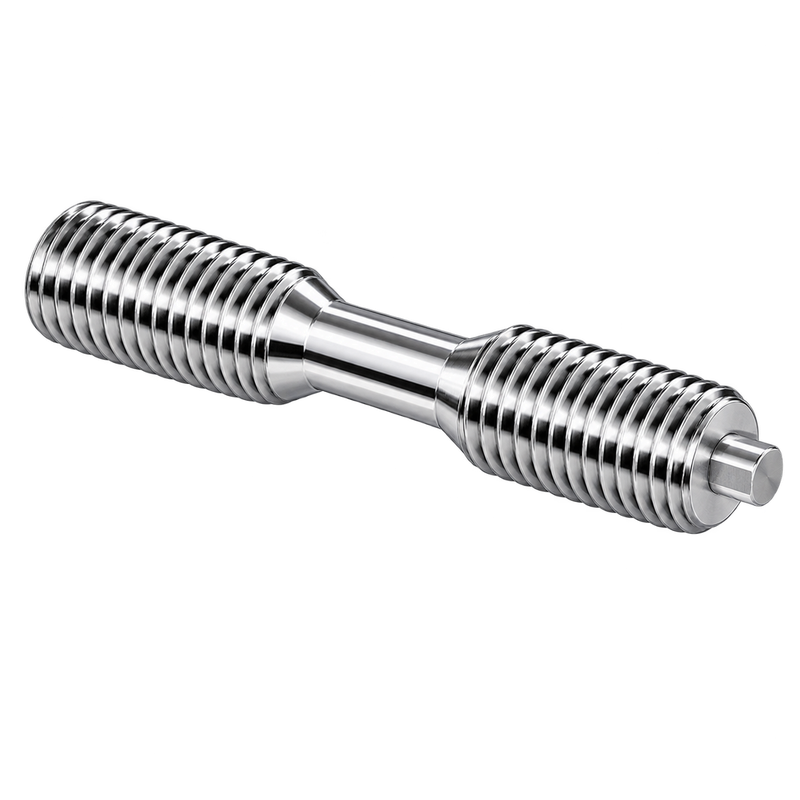
- Stud bolt with reduced (waisted) shank and a pin with two flats on one end
- Standard
- DIN 2510-3 stud bolts, Form L and Form K, or your drawing
- Thread
- Metric coarse thread with large clearance to DIN 2510-2
- Materials
- ASTM stud grades such as A193 B7, B16, A320 L7 and A453 660 (A-286), as your specification calls for
- Documents
- Mill test reports traceable to the heat
How Waisted Studs Work
A waisted stud has a thread on each end and a shank turned down to about the thread root diameter between them. Each end of the shank blends into the thread with a 20° taper and a radius, so there is no sharp step to concentrate stress.
Because the shank is thinner than the thread, the stud stretches along its full length when it is tightened. That extra elastic stretch helps the joint hold its preload through heat cycles, gasket relaxation and vibration, and it improves fatigue life. This is why DIN 2510 bolting is common on turbines, high-pressure valves, steam and process piping, and pressure vessel flanges.
Waisted studs are often tightened with hydraulic bolt tensioners. DIN 2510-2 gives the external thread a larger clearance for this kind of tightening and to help prevent seizing at high temperature.
DIN 2510 Parts and Forms
DIN 2510 is a series of standards for bolted connections with reduced shank. Part 1 is the overview, part 2 the large-clearance thread, part 3 stud bolts, part 4 studs, part 5 hex nuts, part 6 cap nuts, part 7 extension sleeves and part 8 tapped holes.
DIN 2510-3 stud bolts come in several forms:
- Form L: longer thread length b1 on each end, for standard hex nuts.
- Form K: shorter thread length b2, about equal to the nominal diameter.
- Forms KU, Z and ZU: variants for other nut arrangements, including cap nuts on both ends.
Larger sizes in the standard add a heating bore through the stud so it can be heated for tightening. If your drawing calls for a form, size or feature not shown here, send it to us and we will quote to it.
Dimensions, Form L and Form K
Typical DIN 2510-3 dimensions in inches, converted from the metric values in the standard. Thread sizes keep their metric names, with the pitch shown as the equivalent threads per inch (TPI). The nominal length l1 is chosen to suit the joint. Form L is not listed for M56.
| Size | Nominal Ø | TPI (pitch P, mm) | Shank d2 | Thread b1 (Form L) | Thread b2 (Form K) | Pin d3 | Pin z2 | Pin flats SW |
|---|---|---|---|---|---|---|---|---|
| M12 | 0.472 | 14.51 (1.75) | 0.335 | 0.787 | 0.512 | 0.315 | 0.157 | 0.276 |
| M16 | 0.630 | 12.70 (2) | 0.472 | 0.906 | 0.630 | 0.472 | 0.197 | 0.394 |
| M20 | 0.787 | 10.16 (2.5) | 0.591 | 1.102 | 0.787 | 0.551 | 0.236 | 0.433 |
| M24 | 0.945 | 8.47 (3) | 0.709 | 1.260 | 0.945 | 0.551 | 0.236 | 0.433 |
| M27 | 1.063 | 8.47 (3) | 0.807 | 1.378 | 1.063 | 0.709 | 0.236 | 0.512 |
| M30 | 1.181 | 7.26 (3.5) | 0.906 | 1.535 | 1.181 | 0.709 | 0.236 | 0.512 |
| M33 | 1.299 | 7.26 (3.5) | 1.004 | 1.654 | 1.299 | 0.984 | 0.354 | 0.866 |
| M36 | 1.417 | 6.35 (4) | 1.083 | 1.772 | 1.417 | 0.984 | 0.354 | 0.866 |
| M39 | 1.535 | 6.35 (4) | 1.201 | 1.890 | 1.535 | 1.102 | 0.394 | 0.945 |
| M42 | 1.654 | 5.64 (4.5) | 1.280 | 2.047 | 1.654 | 1.102 | 0.394 | 0.945 |
| M45 | 1.772 | 5.64 (4.5) | 1.398 | 2.165 | 1.772 | 1.260 | 0.433 | 1.063 |
| M48 | 1.890 | 5.08 (5) | 1.476 | 2.283 | 1.890 | 1.260 | 0.433 | 1.063 |
| M52 | 2.047 | 5.08 (5) | 1.614 | 2.441 | 2.047 | 1.417 | 0.472 | 1.181 |
| M56 | 2.205 | 4.62 (5.5) | 1.732 | – | 2.205 | 1.575 | 0.512 | 1.260 |
These values are for reference. Check them against the current edition of DIN 2510 and your drawing before ordering. You can draw any of these sizes to scale with our fastener drawing generator.
Materials and Marking
We make DIN 2510 studs in ASTM bolting grades that are readily available in the US, matched to the temperature and service of the joint:
- A193 B7 and B7M: chromium-molybdenum alloy steel for general high-temperature and high-pressure service
- A193 B16: chromium-molybdenum-vanadium alloy steel for higher-temperature service
- A320 L7 and L43: alloy steel for low-temperature service
- A453 660 (A-286): iron-nickel-chromium alloy for elevated-temperature service
- A193 B8 and B8M: austenitic stainless steel for corrosive service
Studs are marked with the manufacturer’s symbol and the ASTM grade symbol, such as B7 or B16. Tell us the grade your specification calls for and we will quote to it. Compare grades in our Fastener Materials Matrix.
Ordering Details
A DIN 2510 stud bolt is designated by form, size, length and material grade, for example:
Stud bolt DIN 2510 – L M30 × 7.874 in – B7
That is a Form L stud, M30 thread, nominal length l1 of 7.874 in, in ASTM A193 B7. To quote, tell us:
- Form (L, K or other) and size, for example M36.
- Nominal length l1 in inches.
- Material and any marking requirements.
- Matching nuts, if you need them, and quantity.
If you have a drawing, upload it and we will make the studs to it. You can also build one with our drawing generator and send it straight to our team.
DIN 2510 Waisted Studs FAQ
What is a waisted stud bolt?
A waisted stud bolt, also called a reduced-shank or anti-fatigue stud, has its shank turned down to about the thread root diameter between the two threads. The thinner shank stretches more evenly under load, which gives the joint more elastic stretch and better fatigue resistance than a full-diameter stud.
What does DIN 2510 cover?
DIN 2510 is the German standard series for bolted connections with reduced shank, used on high-pressure, high-temperature joints such as turbine casings, valves and pressure vessel flanges. Its parts cover the overview, the large-clearance thread, stud bolts, studs, hex nuts, cap nuts, extension sleeves and tapped holes.
What is the difference between Form L and Form K?
Both are stud bolts to DIN 2510-3 with a waisted shank and a pin on one end. Form L has a longer thread length b1 on each end for standard hex nuts, while Form K has a shorter thread length b2, roughly equal to the nominal diameter.
Why does DIN 2510 use a special thread?
DIN 2510-2 specifies a metric thread with larger clearance on the external thread. The extra clearance suits hydraulic tightening of waisted studs and helps reduce seizing and galling at high service temperatures.
What is the pin on the end of a DIN 2510 stud?
The short pin with two flats on one end lets you hold or turn the stud with a wrench while a nut is run on or off. It is not counted in the nominal length l1.
Can I draw a DIN 2510 stud before I order?
Yes. Our free fastener drawing generator draws Form L and Form K waisted studs from the DIN 2510-3 table, or with your own dimensions in Specialty mode. You can download the PDF or send it to us for a quote.
Request a Quote
Send us the form, size, length l1, material and quantity, or upload your drawing. Our team will confirm the details and lead time. Call (281) 581-0176 or request a quote.