Every bolt grade has a room temperature strength printed in its specification. Put that bolt on a hot flange, turbine casing or furnace header and the number starts to fall. How fast it falls, and how long the bolt holds its load at temperature, depends on how the alloy gets its strength. This article explains what happens to alloy steel and nickel alloy bolting as temperature rises, with charts of typical yield strength from room temperature to 1,500 °F.
Two ways heat takes strength away
Heat affects a bolt in two different ways, and it helps to keep them apart.
- Short-time strength loss. Atoms vibrate more as metal heats up, so it takes less stress to make them slip. Yield strength, tensile strength and the modulus of elasticity all drop. A tensile test run at temperature measures this loss. It happens right away and mostly reverses on cooling, as long as the metal itself has not been changed.
- Time-dependent loss. Above a certain temperature, metal slowly stretches under a constant stress. This is creep. In a bolted joint, where the stretch is fixed by the flanges, the same effect shows up as stress relaxation: the bolt load falls over time with no visible movement. This loss does not reverse. A relaxed bolt stays relaxed when the unit cools down.
A third effect matters for heat-treated grades. If the bolt runs close to the temperature at which it was tempered or aged, the heat treatment keeps going. The metal slowly softens, and the room temperature strength on the certificate no longer applies.
Yield strength versus temperature
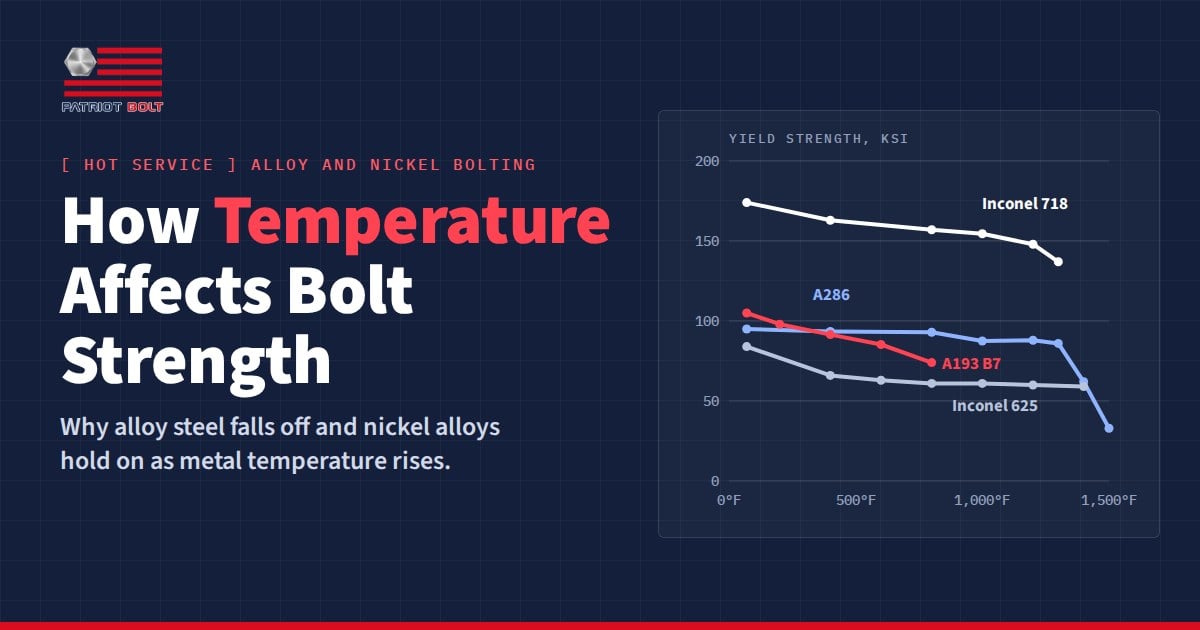
Figure 1 shows yield strength from room temperature up to 1,500 °F for the alloy steel and nickel alloy grades most often used for hot bolting. The B7 curve uses the ASME Section II Part D minimum yield values for studs 2-1/2 in. and under. The nickel alloy curves use typical producer data for the usual bar condition: aged for 718, A286 and K-500, and solution annealed for 625 and C-276. Typical values are averages, not guaranteed minimums.
Figure 1
Yield strength versus temperature
The chart shows how differently these alloys behave. Inconel 718 starts highest and stays highest, still near 150 ksi at 1,200 °F. A286 starts at only 95 ksi but holds almost flat to 1,300 °F. B7 starts above A286 but falls steadily, and by 800 °F it is below A286. Inconel 625 and Hastelloy C-276 lose a large share of their strength early and then hold a low, nearly level line.
Figure 2 shows the same data as a percentage of each alloy’s own room temperature yield. This is the clearest way to compare how the alloys hold up.
Figure 2
Percent of room temperature yield retained
| Alloy | Basis | 70 °F | 400 °F | 800 °F | 1,000 °F | 1,200 °F |
|---|---|---|---|---|---|---|
| A193 B7 | ASME minimum | 105 | 91.5 (87%) | about 74 (70%) | not used* | — |
| Inconel 718 | Typical | 174 | 163 (94%) | 157 (90%) | 154.5 (89%) | 148 (85%) |
| A286 | Typical | 95 | 93.5 (98%) | 93 (98%) | 87.5 (92%) | 88 (93%) |
| Monel K-500 | Typical | 110 | 105 (95%) | 102 (93%) | 90 (82%) | — |
| Inconel 625 | Typical | 84 | 66 (79%) | 61 (73%) | 61 (73%) | 60 (71%) |
| Hastelloy C-276 | Typical | 52.9 | 38.2 (72%) | 32.7 (62%) | 32.8 (62%) | — |
Yield strength in ksi, with the percentage of room temperature yield in brackets. *B7 is not normally used for sustained service at 1,000 °F. The code allowable stress at that temperature is only 4.5 ksi (Figure 3). Larger B7 diameters start from lower minimums (95 ksi over 2-1/2 to 4 in., 75 ksi over 4 to 7 in.).
Why alloy steel falls off
B7 and B16 are quenched and tempered chromium-molybdenum steels. Quenching makes a hard, strong structure (martensite), and tempering softens it in a controlled way to get toughness. ASTM A193 requires a minimum tempering temperature of 1,100 °F for B7 and 1,200 °F for B16.
Tempering does not stop when the bolt leaves the furnace. At service temperatures the carbides in the steel keep growing slowly, and creep becomes active. B7 holds its strength reasonably well up to about 700 °F. Above that, the time-dependent effects take over very quickly. You can see this in the allowable stresses the design codes publish.
Figure 3
Allowable stress for A193 B7 drops sharply above 700 °F
From 700 °F to 1,000 °F the allowable stress falls by more than 80%, from 25.0 ksi to 4.5 ksi. Up to about 700 °F the allowable is set from short-time yield and tensile strength. Above that it is set from creep and stress-rupture data, which fall much faster with temperature. That is why B7 is normally used for flanges up to about 750 to 800 °F.
B16 adds vanadium and is tempered 100 °F hotter. The vanadium forms fine, stable carbides that resist softening and slow down creep, so B16 holds its clamp load to a higher temperature, typically about 1,000 to 1,100 °F. For proof of hot performance, ASTM A193 lets the buyer order a stress-rupture test on B16 at 1,100 °F and 20 ksi (Supplement S12, marked B16R). Our article on high-temperature effects on B7 and B16 bolting compares the two grades in detail.
Why nickel alloys hold on
Nickel alloys keep their strength to higher temperatures because nickel’s crystal structure resists creep better than steel, and because of how these alloys are strengthened. They fall into two groups.
Precipitation-hardened alloys: 718, A286 and K-500. These are solution treated and then aged, which grows very fine particles inside the metal that block slip. Inconel 718 uses a nickel-niobium phase, while A286 and Monel K-500 use a nickel-aluminum-titanium phase. As long as service stays well below the aging temperature, the particles stay put and the strength stays close to its room temperature value. That is the flat plateau in Figures 1 and 2.
- Inconel 718 keeps about 85% of its yield at 1,200 °F. Above about 1,300 °F the strengthening phase starts to coarsen and change, and strength drops quickly. Typical data show yield near 110 ksi at 1,400 °F.
- A286 (ASTM A453 Grade 660) is an iron-nickel-chromium alloy with about 25% nickel. It holds about 90% of its yield to 1,300 °F, then falls to about 62 ksi at 1,400 °F and 33 ksi at 1,500 °F.
- Monel K-500 is aged at about 1,100 °F, which is much lower than 718 or A286. It holds over 90% of its yield to 800 °F, but long exposure in the 900 to 1,100 °F range over-ages it and the strength drifts down toward the annealed level. It is mainly a high-strength corrosion alloy, not a hot bolting alloy.
Solution-annealed alloys: 625 and C-276. These get their strength from alloying elements such as molybdenum, chromium and niobium dissolved in the nickel, with no aging step. The typical pattern is a drop of 25 to 40% between room temperature and 400 to 600 °F, then a long, nearly level stretch. Inconel 625 holds about 60 ksi all the way to 1,400 °F. Hastelloy C-276 holds about 33 ksi to 1,000 °F. Two cautions apply:
- Their absolute strength is low, so a 625 or C-276 stud cannot take the same preload as a B7, B16 or 718 stud of the same size. The joint design has to account for that.
- Long exposure of 625 in the 1,200 to 1,600 °F range raises its strength but cuts its ductility. In typical producer data, 2,000 hours at 1,200 °F lowered room temperature elongation from 54% to 30%.
Strength at temperature in a real joint
A bolt at temperature does not just carry the preload put in at assembly. If the flange and the bolt expand at different rates, the bolt load changes on heat-up. The worst case is low-alloy bolting on a stainless steel flange, because stainless expands faster.
Here is a worked example using ASME Section II Part D properties. B7 studs on a 304 stainless flange heat from 70 to 600 °F. At 600 °F the B7 modulus is 26.9 million psi, the stainless expands at 9.9 millionths per °F and the B7 at 7.4 millionths per °F. The extra stress in the stud is the modulus times the difference in expansion times the temperature rise: 26.9 × (9.9 − 7.4) × 530 ≈ 35.6 ksi.
Figure 4
Preload plus thermal stress versus yield at temperature
With a 55 ksi assembly preload, the stud would see about 91 ksi in service. That is comfortably below the 105 ksi room temperature yield, but above the 85.3 ksi yield at 600 °F. The stud can yield on heat-up, and when the unit cools the joint has lost gasket load and may leak. In practice the gasket and flange also give a little, which reduces the peak, but the lesson stands: check the bolt against its yield strength at temperature, not at room temperature.
The modulus effect works the other way. The B7 modulus drops from about 29.5 million psi at 100 °F to 26.9 million psi at 600 °F, about 9% lower. If the flanges and bolts expand together, the bolt holds the same stretch at a lower modulus, and so carries slightly less load. Our engineering unit converter handles psi, ksi and temperature conversions for these calculations.
Load loss over time: relaxation
Short-time strength tells you whether the bolt will yield. Relaxation tells you how much load it will still have after months at temperature. It is the main reason hot joints leak after a long run.
Figure 5
How bolt load changes at temperature
BS 4882, the British standard for bolting in high-temperature pressure service, gives service limits based on stress relaxation. It puts B7 at 752 °F, B16 at 932 to 968 °F and A286 at 1,202 °F. Above those temperatures, relaxation removes too much of the initial bolt load for reliable sealing. The limits line up closely with the points where the allowable stresses in Figure 3 start to fall.
Hot retorque during start-up can recover load lost to gasket creep and early relaxation. It does not fix a bolt grade that is wrong for the temperature. See Relaxation and Retorque Passes for the PCC-1 guidance, and Thread Lubricant Temperature Ratings for choosing an anti-seize for hot service.
Temperature limits at a glance
Figure 6 puts the typical service ceilings side by side, with the heat-treatment temperature marked where it matters. Notice that for every heat-treated grade, the typical ceiling sits well below the tempering or aging temperature.
Figure 6
Typical service ceiling, upper limit and heat-treatment temperature
Choosing bolting for hot service
- Use the metal temperature, not the process temperature. Bolts on an insulated flange run close to the fluid temperature. Bolts on a bare flange run cooler.
- Check yield at temperature, including thermal stress from mixed materials such as alloy steel bolts on stainless flanges.
- Check the time-dependent limit. Above about 700 °F for B7, the code allowable stress and relaxation limit, not the hot tensile strength, govern.
- Stay well below the tempering or aging temperature of the bolt and the nut.
- Match the nut. Use A194 nuts rated for the temperature, for example Grade 4, 7 or 16 with B16, or a nut in the same nickel alloy as the stud.
- Size for low-strength alloys. If corrosion calls for 625 or C-276, confirm the joint can seal at the lower preload these alloys can carry.
- Plan for disassembly. Use an anti-seize rated for the temperature, and expect higher breakout torque after long hot service.
Frequently asked questions
How much strength does B7 lose at high temperature?
The ASME minimum yield for B7 2-1/2 in. and under drops from 105 ksi at room temperature to 85.3 ksi at 600 °F, about 19% lower, and to roughly 74 ksi at 800 °F. Above about 700 °F creep takes over, and the ASME B31.1 allowable stress falls from 25.0 ksi to 4.5 ksi at 1,000 °F.
Which bolting alloy keeps the most strength at 1,000 to 1,200 °F?
Of the common bolting alloys, Inconel 718 keeps the highest strength, with typical yield near 150 ksi at 1,000 to 1,200 °F. A286 keeps roughly 88 to 90 ksi to about 1,300 °F and is often chosen where 718 is more strength than the joint needs.
Why does Inconel 625 or Hastelloy C-276 look weak at temperature?
Solution-annealed alloys such as 625 and C-276 lose a quarter to a third of their room temperature yield by 400 to 600 °F, then level off. Their strength is low to begin with, so the bolt size and preload must be designed around it. They are usually chosen for corrosion resistance, not hot strength.
Is the hot tensile strength the only thing to check?
No. Above roughly 700 °F for alloy steel and higher for nickel alloys, creep and stress relaxation control how much load the bolt keeps over months of service. Design codes base allowable stresses in this range on creep and stress-rupture data, not on short-time tensile tests.
High-temperature bolting for your next job? Patriot Bolt manufactures stud bolts and heavy hex nuts in B7, B16, A286, Inconel 718, Inconel 625, Monel K-500 and Hastelloy C-276. Compare grades in our materials guide, or send us your bolting list or call (281) 581-0176. Patriot Bolt manufactures bolting and does not perform bolting, training or joint assembly services.